Humming, fan not spinning
The outdoor unit buzzes while the fan on top stays still. The classic sign.
Mon–Fri 7 AM–4 PM
Common repairs · Capacitor
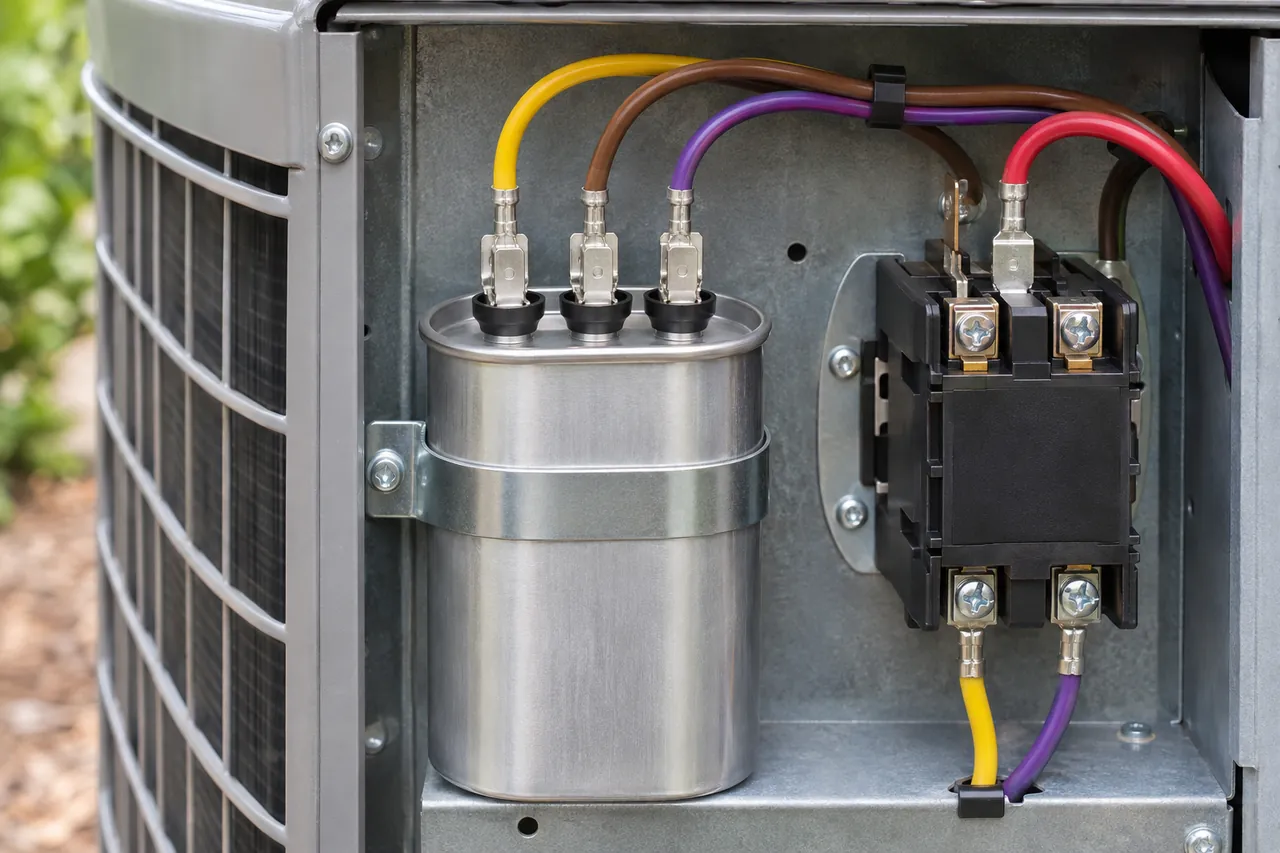
If the outdoor unit hums but the fan will not spin, or the system clicks and never starts, a small silver can is the likely reason. It is the cheapest major repair on an air conditioner, when it is diagnosed correctly.
Or call (512) 692-7191 · Mon–Fri 7 AM–4 PM
What it does
A capacitor stores a jolt of electricity and releases it to start the compressor and fan motors, then keeps them running smoothly.
Most home systems use a dual run capacitor: one can serving both the compressor and the outdoor fan. Its strength is measured in microfarads, and it only has to drift a little below its rating before motors start to struggle.
Heat is what wears it out. A capacitor inside a metal cabinet in an Austin summer lives at well over 120°F for months, and power surges from thunderstorms finish off the weak ones. That is why they fail in clusters during the first real heat wave.
Symptoms
The outdoor unit buzzes while the fan on top stays still. The classic sign.
You hear the contactor pull in, a hum, then nothing.
The compressor trips its overload after a few seconds or minutes and tries again later.
The indoor fan runs normally while the outdoor unit does nothing.
A domed top or oily residue on the can means it has already failed.
A weak capacitor makes motors draw more current long before they stop.
The repair
Swapping the part takes minutes. Making sure it was the real problem is the rest of the visit.
The disconnect is pulled and the circuit is tested dead before anything is touched.
It is safely discharged and its microfarad reading compared with the rating printed on the can.
Same microfarad values and a voltage rating equal to or higher than the original. A near-match shortens motor life.
Compressor and fan amp draws are checked against their nameplates, and the contactor is inspected.
A capacitor can hold a dangerous charge with the power off, and the wires next to it carry 240 volts when the power is on. It is a real shock hazard, not a formality.
There is also a diagnostic risk. A capacitor often fails because a motor is drawing too much current. Replace only the capacitor and the new one fails within weeks, or the motor burns out. Measuring amp draws afterwards is what separates a repair from a guess.
Pricing
| Job | Typical range | Notes |
|---|---|---|
| Capacitor replacement | $150–$400 | Part, labor and testing. Dual capacitors cost a little more than single ones. |
| Capacitor and contactor together | $250–$600 | Common when the contactor is pitted or full of ants. |
| Hard-start kit added | $150–$350 | For a compressor that still struggles to start with a good capacitor. |
| Condenser fan motor and capacitor | $350–$900 | When the motor itself has failed. |
Market ranges for the Austin area, not a quote. The part itself is inexpensive: you are paying for the visit, the testing and the certainty that it was the real cause. Full list in the AC repair cost guide.
Questions
Something else on your mind? Call (512) 692-7191 and ask the technician directly.
Typically $150–$400 including the part, labor and testing. If the contactor is replaced at the same time, expect $250 to $600. You approve one flat price before the work starts.
It is physically simple and genuinely dangerous. The capacitor can hold a charge with the power off, and a wrong rating damages the compressor. If you do not own a meter that reads microfarads and know how to discharge a capacitor safely, leave it alone.
Roughly five to ten years in Texas heat, less after power surges or when a motor is failing. A yearly tune-up measures it, so a weak one can be replaced before it leaves you without cooling.
Yes. A weak capacitor makes the compressor start hard and run hot, which shortens its life. Replacing a capacitor that is failing is one of the cheapest ways to protect the most expensive part of the system.
Repeated failures point to something else: a fan motor or compressor drawing too much current, poor power quality, a capacitor with the wrong rating, or a low-grade part. The cause needs to be found, not just the capacitor replaced again.
Ready when you are
Leave your number and get a call back during business hours, or call now. You hear the likely cause, the timing and how pricing works before anyone rolls a truck.
(512) 692-7191Mon–Fri 7 AM–4 PM